
The data our AI processes for every NBA game
The NBA produces a staggering volume of data: 82 games per team in the regular season alone, totaling over 1,200 matchups each year. No human bettor can process that amount of information with the speed and rigor of an algorithm. That is exactly where our artificial intelligence comes in.
Before generating a pick on the Moneyline, Spread or Over/Under, our system ingests several categories of data. Schedule first: back-to-back situations (two games in two nights) cause a measurable drop in performance, especially on the road. We factor in rest differentials, travel sequences and total miles covered.
Injuries and rotations form the second pillar. Confirmed absences and official injury reports are incorporated at the time the prediction is generated. Beyond the binary "playing / not playing" status, we analyze recent minutes logged by starters to detect abnormal workloads that often precede a scheduled rest day.
Finally, our AI cross-references head-to-head records over three seasons, each franchise's recent form (winning and losing streaks, home vs. away performance) and sportsbook odds. Comparing our calculated probabilities against market lines is how we identify value bets — situations where the sportsbook underestimates the true likelihood of an outcome.
Our NBA prediction models
Our system does not rely on a single algorithm. We combine four complementary approaches whose outputs are aggregated to produce each pick.
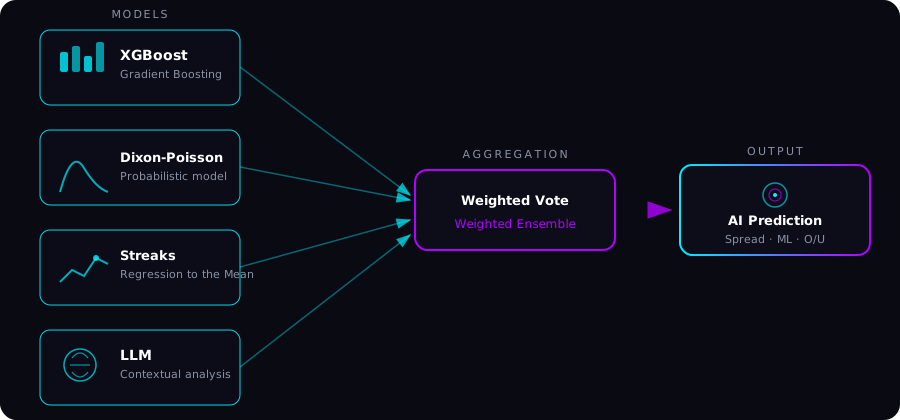
XGBoost — The statistical engine
XGBoost (Extreme Gradient Boosting) is a machine learning model trained on hundreds of statistical features: pace, offensive rating, defensive rating, rebounds, turnovers, shooting percentage by zone. It is our primary engine for Spread and Over/Under markets because it excels at weighing the relative importance of each variable based on game context.
Dixon-Poisson — Probabilistic modeling
The Dixon-Poisson model estimates the final score by independently modeling each team's attacking strength and defensive solidity. Unlike XGBoost, which reasons in terms of "likely margin," Dixon-Poisson produces a full distribution of possible scores. This model is particularly effective on Moneyline picks and tight-odds matchups.
Streaks and Regression to the Mean
Will a team on an eight-game winning streak keep rolling? Not necessarily. Our streak analysis module calculates the probability of regression to the mean, factoring in strength of schedule, the natural variance of basketball and the gap between actual and expected performance. This module tempers recency bias — a trap that catches many bettors.
LLM — Contextual analysis
Our Large Language Model adds a dimension that purely statistical models cannot capture. It parses detailed injury reports, coaches' press conferences and the qualitative context of a game (rivalry, playoff seeding implications, end-of-season dynamics). These signals are translated into probability adjustments that feed the final aggregation.
Why 82 games change everything for AI
What sets the NBA apart for an AI prediction system is volume. With 82 games per team (compared to 17 in the NFL or 38 in top European soccer leagues), the training dataset is massive. Our models have enough data to detect statistically significant patterns — not just coincidences.
The dense schedule — a game roughly every other day — creates inefficiencies in the lines that sportsbooks don't always adjust fast enough. Cumulative fatigue is measurable and predictable: our data shows that late-season performance follows decline curves that our AI detects before the market does.
The bottom line: the higher the game volume, the greater the edge artificial intelligence holds over human intuition. From that standpoint, the NBA is the ideal playground for our algorithms.